

The Madhya Pradesh High Court has ruled that if a GST E-way bill contains an incorrect destination city, it cannot simply be considered a minor typing error, especially if the goods have travelled significantly beyond the stated location. According to Section 129 of the Goods and Services Tax Act, imposing a penalty of 100% is appropriate in such cases.
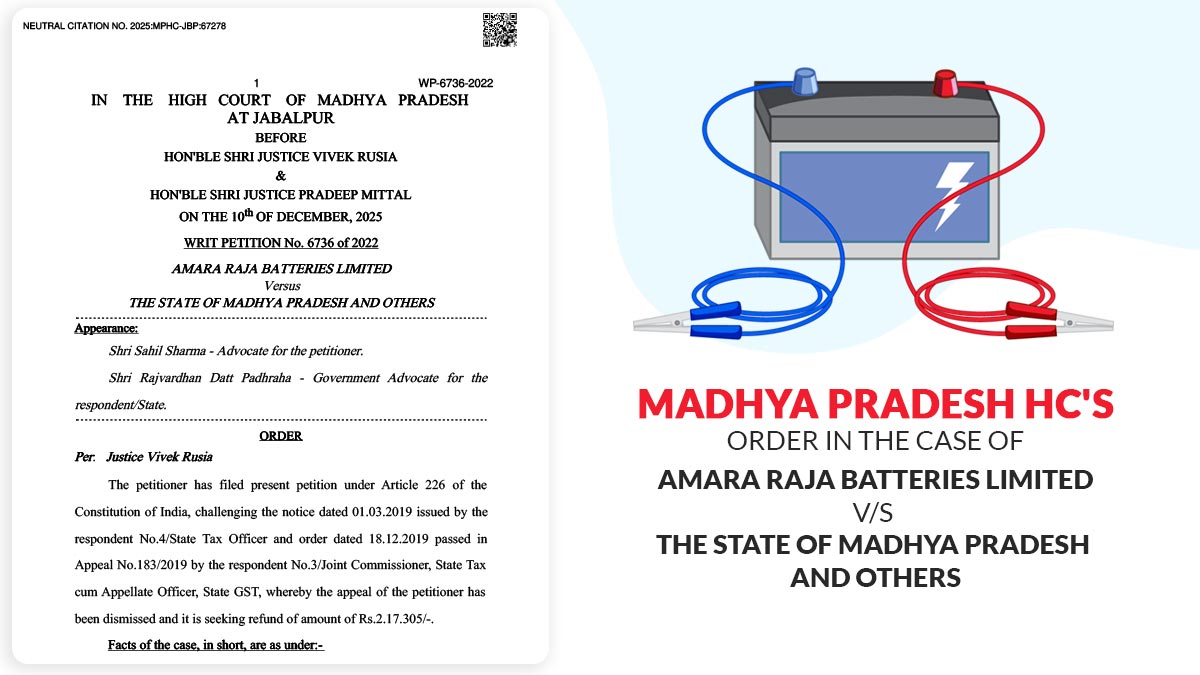
Amara Raja Batteries Limited filed a writ petition in the High Court regarding a notice received on March 1, 2019, from the State Tax Officer, as well as an appeal order issued on December 18, 2019, by the Joint Commissioner of State Tax. As a result of this issue, a penalty of ₹2,17,305 was imposed, and the applicant’s appeal was denied.
The applicant makes lead-acid batteries and is registered for Goods and Services Tax (GST). They have offices in two cities in Madhya Pradesh: Indore and Jabalpur, both using the same GST number. Additionally, they have a warehouse in Ahmedabad. On February 26, 2019, the applicant shipped 56 batteries from their warehouse in Ahmedabad to their warehouse in Jabalpur.
The goods had three invoices and a consignment note. IGST and SGST of Rs. 2,17,305 were paid. However, at the time of creating the E-way bill, the destination was incorrectly written as Indore instead of Jabalpur.
GST officers on 1 March 2019 stopped the vehicle with the goods. They checked and discovered that the truck had passed Indore and was near Bhopal, even though the e-way bill mentioned Indore as the last destination. They discovered this as a violation of Section 129 of the M.P. GST Act. Therefore, they held the goods and vehicles and allowed them to go merely after the applicant filed a penalty equal to 100% of the tax. The applicant filed the same under protest and after that appealed, though the appeal was dismissed.
The lawyer of the applicant mentioned that the wrong destination on the e-way bill was an honest typing error by a worker and no intent was there to evade tax, since the whole tax had been filed earlier. They mentioned the same case comes within a CBIC circular on 14 September 2018, which says no action u/s 129 for small mistakes in the buyer’s address.
The State’s lawyer stated that Section 129 mandates a fixed penalty that cannot be reduced, even if the error was made in good faith. They argued that the mistake was not just a minor error in area or address, but a complete change of city, with the vehicle having travelled well beyond the specified city. They also emphasised that GST officers rely entirely on the details of the E-way bill to monitor the movement of goods.
A Division Bench with Justice Vivek Rusia and Justice Pradeep Mittal cited that the sender and receiver were the same company and the applicant had offices in Ahmedabad, Indore, and Jabalpur. The court observed that while the invoices said Jabalpur as the destination, the E-way bill said Indore, and the applicant had time during the trip to correct the mistake, but did not.
The court said that Clause 5(c) of the GST circular applies merely to small mistakes in address in the same area. In this, the destination city was incorrect; therefore, it could not be considered a small or technical mistake. No evidence was shown by the applicant to prove that the goods were for the Jabalpur warehouse, the court mentioned.
The court decided the penalty was charged correctly, and the appeal body appropriately refused the appeal. The writ petition was dismissed, and no support was provided to the applicant.
| Case Title | Amara Raja Batteries Limited vs. The State of Madhya Pradesh and Others |
| Case No. | WRIT PETITION No. 6736 of 2022 |
| For Petitioner | Shri Sahil Sharma |
| For Respondent | Shri Rajvardhan Datt Padhraha |
| Madhya Pradesh High Court | Read Order |