

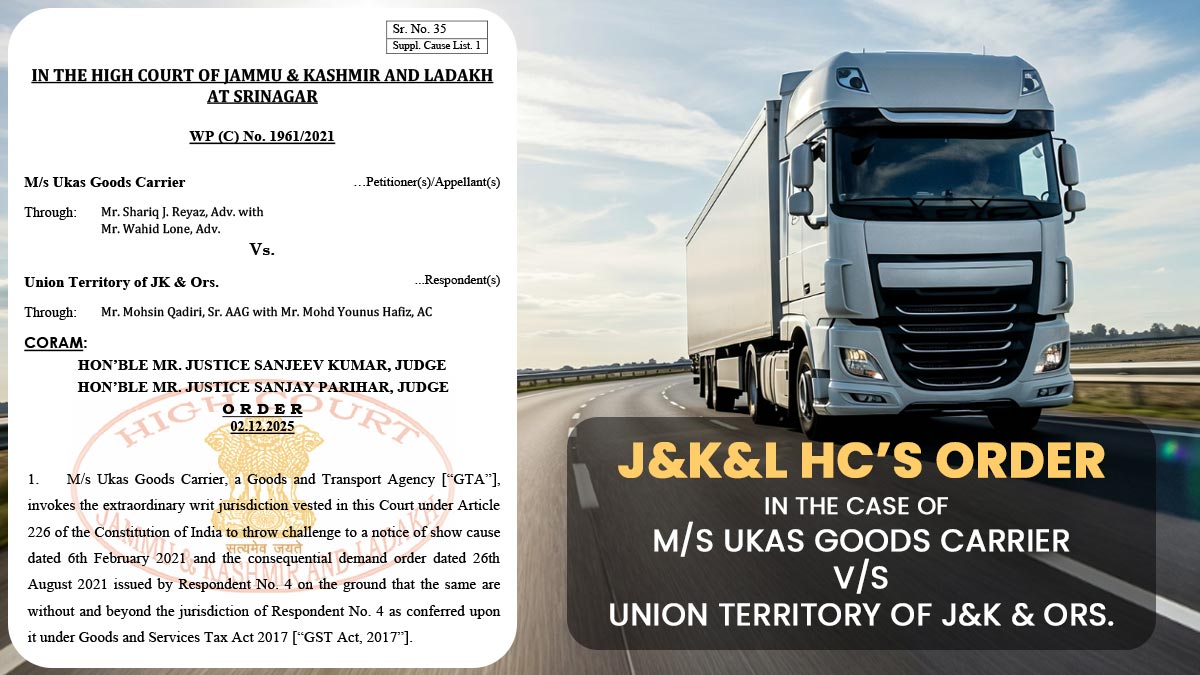
The High Court of Jammu & Kashmir and Ladakh has decided that when the tax authorities issue a notice for unpaid Goods and Services Tax (GST), the amount they can demand cannot be more than what is stated in that notice. This means that if they try to charge more, it goes against the principles of fairness.
The Division Bench of Justice Sanjeev Kumar and Justice Sanjay Parihar, after finding that the final demand was much higher than what was proposed in the original notice, set aside a GST demand raised against a goods transport agency (GTA).
The Goods Transport Agency challenged a Show Cause Notice (SCN) and a subsequent demand order issued by the GST authorities through a writ petition. The applicant argued that, as a Goods Transport Agency, the responsibility for paying GST on transportation services falls on the service receiver under the reverse charge mechanism, rather than on the transporter itself.
The applicant stated that the SCN has issued a tax demand of approximately Rs 4.59 crore, while the final order confirmed a demand of around Rs 7.62 crore.
As per the applicant, this was not permitted under the GST law.
Also Read: How to Effortlessly Check Validity of GST SCN & Orders
The Goods and Services Tax Department opposed the claim of the applicant and stated that the taxpayer had another remedy by way of appeal. It was said that the applicant was engaged in transport services as well as in the supply of goods. But the department cannot explain the way the final demand surpasses the amount cited in the notice.
The High Court Bench at Srinagar said that the GST law demands the SCN to specify the exact tax amount, interest, and penalty being proposed. The taxpayer should get a proper opportunity to answer. The Court stated that the law bars authorities from confirming a demand exceeding that proposed in the notice.
Read Also: How to Respond to a GST Notice for Dual Jurisdiction (SGST & CGST)
It was noted that if the assessing authority wishes to issue a final order for an amount greater than what was specified in the previously issued show cause notice, it may do so by issuing a new show cause notice regarding the excess amount, as long as this new notice is issued within the limitation period.
Keeping that the demand order breached legal provisions along with the principles of natural justice, the Bench quashed both the SCN and the GST demand order.
The HC asked the assessing authority to again consider the case and pass a fresh order as per the law.
| Case Title | M/s Ukas Goods Carrier vs Union Territory of JK & Ors. |
| Case No. | WP (C) No. 1961/2021 |
| For Petitioner | Mr. Shariq J. Reyaz, Adv. with Mr. Wahid Lone, Adv. |
| For Respondent | Mr. Mohsin Qadiri, Sr. AAG with Mr. Mohd Younus Hafiz, AC |
| Jammu & Kashmir and Ladakh High Court | Read Order |