

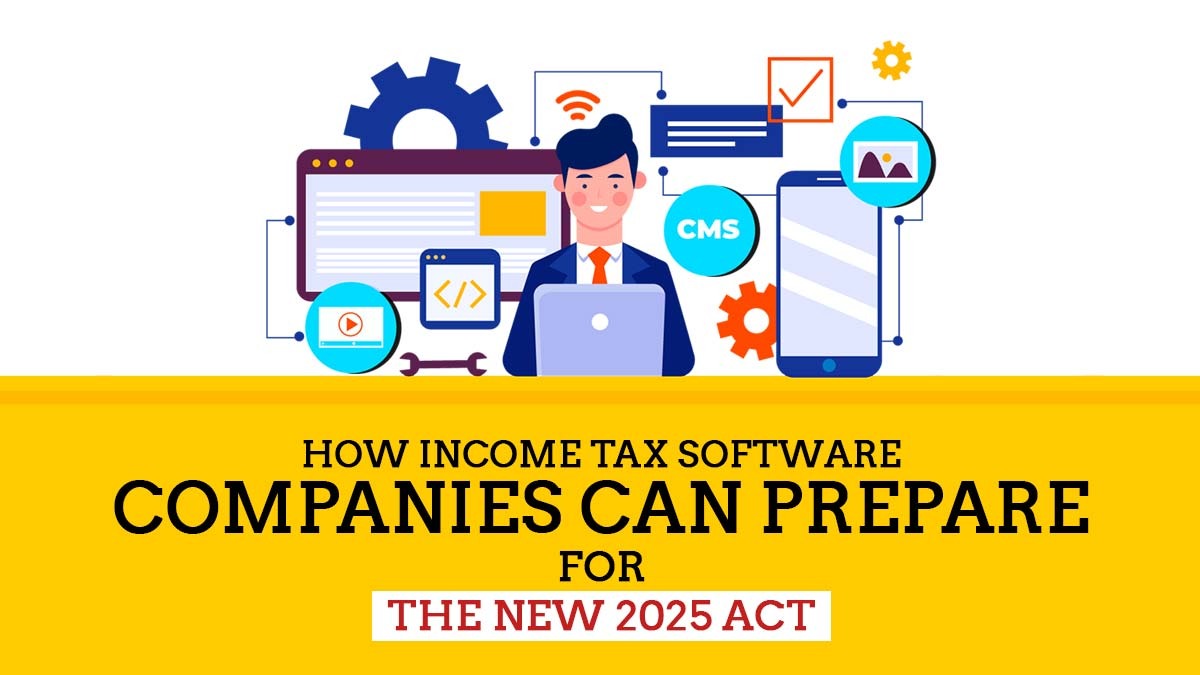
The rollout of the Income Tax Act 2025 marks a significant transformation in India’s tax framework. The purpose of the act is to simplify the tax structure and reduce litigation. It also introduces new compliance expectations, reporting requirements, and procedural changes.
For companies that develop income tax software represents a legislative update to monitor as well as a crucial strategic juncture. Proactive and thoughtful preparation for the new tax regime shall help discover which software providers succeed and which ones stumble to adapt to the evolving landscape.
As India moves towards a new era of tax compliance, income tax software companies need to implement a proactive and multi-dimensional strategy. This approach should ensure that their products, processes, and partnerships are in sync with the requirements set forth by Act 2025.
Such alignment will be crucial for effectively meeting the evolving demands of tax compliance in the country. This Income Tax Act 2025 will take effect from the 1st April, 2026.
Comprehending the Amendments
The initial step for any tax software provider is to comprehend the provisions of the Income Tax Act 2025. This Act has the potential to make significant revisions, unlike the usual incremental changes made each year.
- Tax slabs or rates
- New categories of income
- Updated definitions of exemptions and deductions
- Revised compliance and audit frameworks
- Modernisation of procedural norms and digitisation goals
It is important to have a dedicated legislative review team or a partnership with law firms. Software vendors need to examine how each clause affects return filing logic, computation engines, validation workflows, and reporting formats.
Optimising and Aligning Software Architecture
Companies usually make one common mistake, i.e, they try to adapt to the new tax laws by patching old models. A complete modernisation mindset is needed for the Income Tax Act 2025 rather than that.
Modular Design
Develop modules that can be updated independently without impacting the core stability of the software. For instance, calculation rules should be separate from user interface code. This separation allows for the prompt deployment of changes without major overhauls.
Adopting an API-First Strategy
Many corporate clients put reliance on accounting systems, payroll tools, or ERP platforms. Developing API support ensures easier integration with external data sources and makes updating tax logic streamlined. APIs make it simpler to incorporate future changes without disrupting user experience.
Cloud and Scalability
Modern tax regimes need real-time validation, frequent updates, and high data throughout. Cloud-based solutions provide scalability and enable remote updates, which legacy desktop systems do not offer. Investing in cloud infrastructure has become a competitive necessity.
Improving Data Accuracy and Validation
The emphasis on data integrity and validation checks is expected to surge under the Income Tax Act 2025. Software companies need to develop stronger procedures that reduce errors and ensure consistency in distinct filings.
Intelligent Pre-Validation
The system must validate the following things before a return is generated
- TDS and tax credits
- Income head classifications
- Deduction eligibility
- Computation logic as per the updated act provisions
These pre-validation surges compliance precision and lowers the notices from tax authorities.
Audit Trail and Transparency
Under the age of digital governance, transparency is crucial. Comprehensive audit logs detailing modifications, timestamps, and reasons enhance trust and facilitate efficient responses to queries or notices.
Familiarizing Users
Until users know the process of using the software, no software can be useful. Education and communication strategies are required to prepare for Act 2025.
Tutorials and Webinars
Publish a series of tutorials, video explainers, and webinars on the Income Tax Act 2025. Topics can include:
- Impact of the New Act on Individual Taxpayers
- How businesses must update their reporting
- Best practices for minimising errors
Support Channels
More tax reform directed to more queries. Software companies need to increase support channels to include-
- Chat support
- Email help desks
- Dedicated helplines during peak filing periods
Partnerships with Tax Experts
Software companies do not work in isolation. Collaborating with chartered accountants, tax advisors, and professional bodies assures that the tools built are practical and aligned with real-world demands.
Advisory Panels
Develop advisory panels with industry experts to review product changes and furnish feedback from the viewpoint of a user.
Beta Testing with Firms
Before launching, conduct beta tests with CPA firms or corporate clients. Their practical usage can uncover edge cases and compliance issues that internal teams might overlook.
Ensuring Regulatory Compliance and Security
The software manages important financial and personal information. The digital compliance infrastructure of the government with Act 2025 is anticipated to become stronger and more interconnected. Companies need to prioritise data security, privacy, and regulatory compliance.
Secure Data Storage
Encrypt data both at rest and in transit. Enforce stringent access controls and use multi-factor authentication to safeguard user accounts.
Regular Audits
Perform internal and external security audits. The same prevents data breaches as well as develops credibility with clients who are increasingly aware of cybersecurity risks.
Compliance Readiness
In addition to security, make sure that the software interacts correctly with government portals. The automation of file formats, return uploads, and status checks must align with the official specifications outlined in the new act.
Real-Time Updates and Version Control
Version control is one of the biggest issues with legislative amendments. Software needs to adapt to Act 2025 if it evolves after launch.
Continuous Deployment
Embrace continuous development and deployment practices that permit fast rollouts of patches or enhancements without disrupting users.
Clear Versioning
Maintain version logs so that accountants and business know which tax logic applies to which filing period. Transparent versioning prevents confusion at the time of audits or disputes.
Marketing and Positioning
The Income Tax Act 2025 shows a robust market opportunity that streamlines the software companies to establish themselves as trusted partners and industry thought leaders.
Content Campaigns
Publish articles, infographics, and FAQs on act provisions and software readiness. Familiarise clients with how your solution helps them transition seamlessly.
Customer Outreach
Communicate with the existing clients with tailored messages elaborating the revisions and how your product supports them. Personalised communication develops loyalty and trust.
Forthcoming Vision
The preparation of the Income Tax Act 2025 is more than just mere compliance. It specifies a chance to establish a stringent foundation for the upcoming tax reforms. Some of the Income tax filing software companies that approach this update as a strategic transformation instead of a routine technical modification have the potential to achieve a competitive advantage.
Organisations that invest in modular architectures, promote continuous education, foster expert partnerships, ensure data integrity, and enhance customer experience will obtain resilience for 2025, along with subsequent tax regimes.