

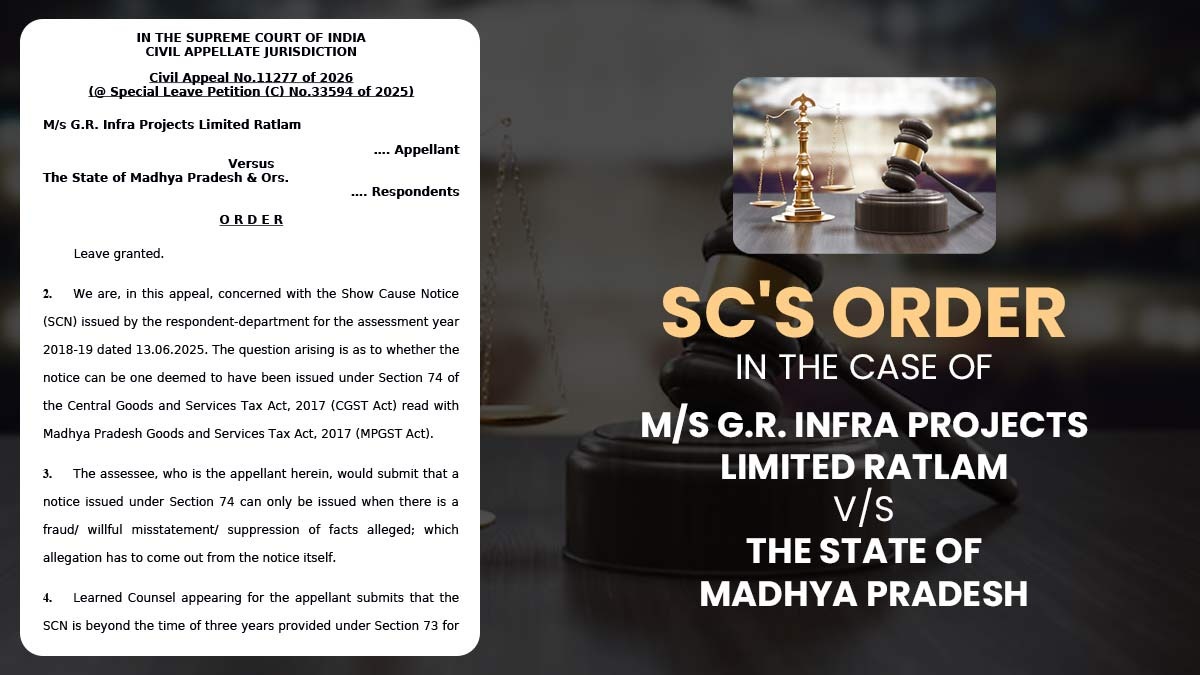
In the GST show cause notice, the provision to extend the limitation period could not be used under Section 74 of the Central Goods and Services Tax Act only by making a “bland statement” alleging fraud or concealment of facts, the Supreme Court stated.
The notice should specify the allegations and circumstances that led the assessing officer to infer fraud, wilful misstatement or suppression of facts, the court cited.
A Bench of Justice JB Pardiwala and Justice K. Vinod Chandran observed this while permitting an appeal submitted by G.R. Infra Projects Limited, Ratlam, against the State of Madhya Pradesh.
The Supreme Court quashed the SCN issued to the company for the AY 2018-19 as well as the Madhya Pradesh High Court order that had upheld it.
Read Also: Best Strategies to Handle GST SCN with Basic Reply Format
‘Bland statement’ of fraud not adequate
The court criticised the language used in the disputed notice.
“A bare reading of the notice” exhibited that, apart from a general statement of “fraud or concealment of facts”, nothing was explaining how fraud had been inferred or how concealment of facts had been detected, the Bench observed.
The court also paid attention to the use of the word “or “ citing that it shows that the assessing officer was unsure whether the proceedings were founded on fraud or concealment of facts.
“A bare reading of the notice would indicate that but for a bland statement of ‘fraud or concealment of facts’ nothing is stated as to how fraud was inferred or concealment of facts was detected. In fact, the ‘or’ employed indicates that even the assessing officer was not sure that the assessment was proceeded by reason of fraud or on the ground of concealment of facts. What is required for the extended time to be applied are the allegations, which lead to the inference of fraud or the concealment as attempted by the assessee resulting in suppression of facts, should emanate from the notice itself. It cannot be a mechanical use of the words ‘fraud, willful misstatement or suppression of facts’ without listing out the aspects which persuade the assessing officer to conclude that there has been employed either of these surreptitious devices by the assessee,” the Court stated.
Important: Karnataka HC Quashes GST Order Over Absence of Fraud Allegation in SCN U/S 74
State cannot supplement defective notice through counter-affidavit
The court quashed an attempt of the State to place reliance on allegations mentioned in its counter-affidavit before the court.
The Apex Court repeated that when an authority furnishes a notice or order, the provisions required to sustain that notice or order must be contained in the document itself. They cannot be supplied afterwards via a counter-affidavit in court.
“We refused to look at the counter-affidavit on the trite principle that when an authority has issued a notice or an order, the requirements to make the notice or order valid should be contained in such notice or order and cannot be supplanted by a counter afidavit in Court, where the notice or order is alleged to be invalid for reason to non-application of mind, the requirements having not met and so on and so forth.”
Section 73 limitation had lapsed
The issue has emerged from a Show Cause Notice (SCN) dated June 13, 2025, pertinent to the 2018-19 assessment year.
Recommended: How GST Software Fixes Common Mistakes in SCN Replies
The court discovered that proceedings u/s 73, which include lesser tax paid or not paid for reasons other than fraud, wilful misstatement or suppression of facts, were already barred by limitation.
The annual return filing due date for FY 2018-19 had been extended to December 31, 2020. The Court, considering the limitation period and the exclusion granted by the Supreme Court in the COVID-19 pandemic, computed that the extended due date for issuing a section 73 notice lapsed on February 28, 2025.
The disputed notice was issued more than three months later. Thus, the State asked to sustain the proceedings u/s 74.
The State’s matter is concerned with an investigation that had started with summons of the company’s business for Fiscal years 2017-18 to 2020-21.
At the premises of the company, an inspection was held, and statements were recorded from its accountant, authorised signatory and director. The company did not attend several scheduled hearings, the State alleged.
On March 3, 2025, a draft notice-cum-investigation report was formed, followed by an intimation under Section 142(1A). After raising objections by the company and serving draft notices, the final SCN was issued u/s 74 on June 13, 2025.
However, the Apex Court stated that the material on which the State relied upon in the investigation could not supersede the absence of allegations in the final statutory notice.
The bench did not find any reason to sustain the SCN and quashed the notice as well as the order of the High Court. The Court asked the State not to take any proceedings as per the notice contested before the HC.
| Case Title | M/s G.R. Infra Projects Limited Ratlam vs. The State of Madhya Pradesh |
| Case No. | Civil Appeal No.11277 of 2026 |
| For Petitioner | Mr Jatin Harjai, Mr Rohan Aggarwal, Ms Nikshubha Sharma, and Mr Vatsa |
| For Respondent | Mr Rudraditya Khare and Ms Mrinal Gopal Elker |
| Supreme Court | Read Order |