

The Parliament, on 13th August 2026, prohibited States from taxing mines and minerals. As per the Mines and Minerals (Development and Regulation) Amendment Act, 2026, states cannot impose taxes on mineral rights and mineral-bearing lands from the date of its publication in the Official Gazette.
Significance of Amendment
In 2024, the Supreme Court ruled that mining royalties are not taxes, though states generally retain the power to tax mineral rights, subject to Parliament’s authority.
Following this, Parliament amended the Mines and Minerals (Development and Regulation) Act to restrict states’ taxation powers to ensure national uniformity and protect economic interests.
This amendment limits the ability of major mining states, including Andhra Pradesh, Odisha, Madhya Pradesh, Chhattisgarh, Karnataka, Tamil Nadu, Goa, Gujarat, and Rajasthan, to levy taxes on mineral rights and lands.
Read Also: CBDT Renames IT Amendment Rules, 2026 as IT (First Amendment) Rules, 2026
What are the Amendments?
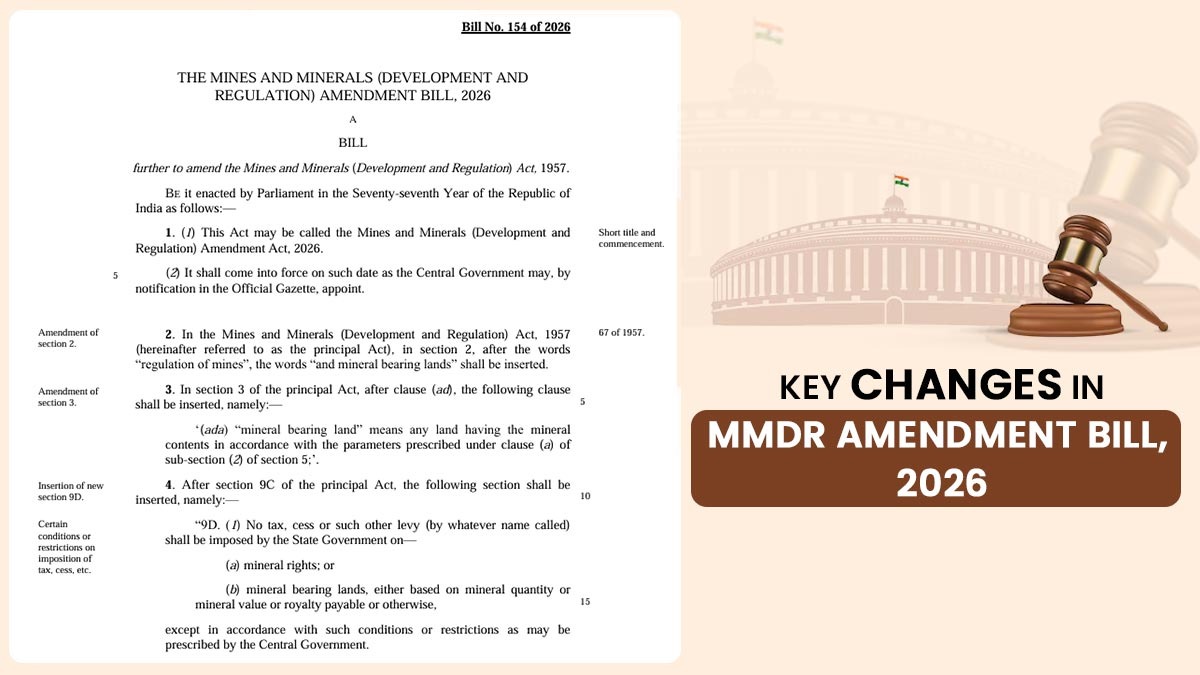
The provision of Section 9D is inserted, which prohibits States from levying tax or cess or any other levy on mineral rights or mineral-bearing lands, either based on mineral quantity or mineral value or royalty payable or otherwise, except as per the restrictions or conditions made by the central government.
The provision safeguards the rights of the people who had pending dues to the State government. The bill specified that any pending dues that are to be paid by the developer / having mineral rights or recovered by the State Government before the commencement of the MMDR Amendment Act, 2026 shall be considered as invalid in all respects. The clause is a non-obstante clause which overrides any other law in force, judgment, decree, court order, etc.
Before the commencement of the Act, the earlier deposited tax, cess or any other levy with the State or recovered by the State will not be liable to refund. The State Government can keep the collected levies.
Section 9D of the bill reads as follows:
“(1) No tax, cess or such other levy (by whatever name called) shall be imposed by the State Government on—
(a) mineral rights; or
(b) mineral bearing lands, either based on mineral quantity or
mineral value or royalty payable or otherwise, except in accordance with such conditions or restrictions as may be prescribed by the Central Government.
(2) Notwithstanding anything contained in any other law for the time being in force, or in any judgment, decree or order of any court, the imposition of any such tax, cess or other levy by the State Government on—
(a) mineral rights; or
(b) mineral bearing lands either based on mineral quantity or mineral value or royalty payable or otherwise,
which is not deposited with the State Government or recovered by it before the commencement of the Mines and Minerals (Development and Regulation) Amendment Act, 2026, shall be deemed to be invalid at all material times:
Provided that any such tax, cess or other levy on mineral rights or on mineral bearing lands, already deposited with the State Government or recovered by it before such commencement, shall not be liable to be refunded.”
Important: Indirect Tax: Definition, Types, Features and Advantages
The Central Government, along with ‘regulation of mines’, added the words “and mineral bearing lands” to Section 2 of the MMDR Act, 1957. Section 2 authorises the Central Government to take control of the regulation of mines and their development in the public interest.
The government, while recognising the importance of minerals as natural resources, has decided to regulate mining and development u/s 2 of the MMDR Act, 1957.
Since the minerals are concentrated in a few states, an uncertain and irregular levying of taxes will affect them.
Read about the MMDR Amendment Bill, 2026