

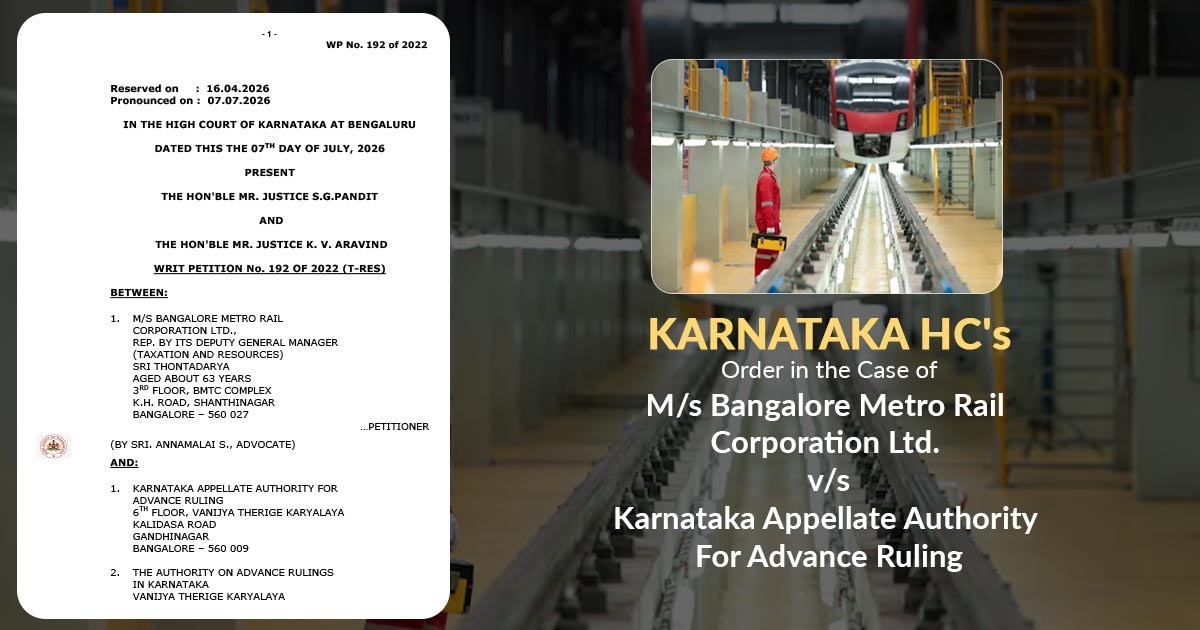
The Karnataka High Court on 7 July stated that a person who is not an applicant or any concerned tax authority in an advance ruling preceding cannot contest the ruling under Article 226 of the Constitution, as such rulings are binding only on the parties to the proceeding.
A Division Bench of Justices S.G. Pandit and K.V. Aravind dismissed Bangalore Metro Rail Corporation Limited’s (BMRCL) writ petition contesting an order of the Karnataka Appellate Authority for Advance Ruling (AAAR), holding that BMRCL does not have any authority to question an advance ruling passed in proceedings to which it was not a party. It said that-
“The petitioner, being a third party and neither the applicant nor the concerned authority, has no locus standi to challenge the order passed by the AAR or the AAAR by invoking Article 226 of the Constitution of India. The ruling rendered by the AAR or the AAAR is a decision in personam and binds only the applicant and the concerned/jurisdictional authority, and not any other party.”
A contract was signed between BMRCL and Bharat Earth Movers Limited (BEML) for the supply of 150 standard-gauge intermediate metro rail cars. As per the agreement, BMRCL should reimburse the applicable Goods and Services Tax (GST) payable by BEML.
Thereafter, BEML approached the Authority for Advance Ruling (AAR) and asked for clarification on the GST classification of the supply. The AAR initially said that the transaction comprises a composite supply. However, the Appellate Authority for Advance Ruling (AAAR) reclassified the different elements of the contract and stated that they attract GST at rates varying from 5% to 28%.
BMRCL contested the AAAR order before the HC, claiming that the changed classification increased its financial obligation as it was contractually needed to reimburse GST payable by BEML.
Read Also: Karnataka HC Quashes GST Order Over Absence of Fraud Allegation in SCN U/S
The court does not accept the challenge, holding that Section 103 of the Central Goods and Services Tax Act, 2017 provides that an advance ruling is binding merely on the applicant who asked for the ruling and the concerned jurisdictional tax authority.
The Court said that such a ruling is a decision in personam and does not bind third parties. It was observed that the agreement signed by BMRCL and BEML did not mention the GST classification of the supplies or the applicable tax rate.
It stated that the reference to the reimbursement of “applicable GST” in the contract referred to the GST calculated according to the law, including the rate determined by the AAAR’s ruling that was accepted by BEML. Consequently, this ruling did not impose any additional contractual obligations on BMRCL. The Bench said that-
“When the contract entered into between the petitioner and respondent No.4 does not provide for the classification of the supply of goods or services, or stipulate the applicable rate of GST, the question of the advance ruling rendered by the AAAR imposing any additional liability, pecuniary burden or civil consequence upon the petitioner does not arise.”
Also, the Bench mentioned that considering the claim of BMRCL would require the court to rewrite the contractual terms by incorporating GST classification and tax rate norms that were not agreed upon by the parties. It said that-
“Such an exercise would, in effect, amount to amending or rewriting the terms of the contract, which is impermissible in exercise of jurisdiction under Article 226 of the Constitution of India.”
Therefore, the High Court overturned the writ petition of BMRCL, holding that it was not maintainable because the corporation does not have the right to contest the ruling of AAAR.
| Case Title | M/s Bangalore Metro Rail Corporation Ltd. vs. Karnataka Appellate Authority For Advance Ruling |
| Case No. | WP No. 192 of 2022 |
| For Petitioner | Sri. Annamalai S. |
| For Respondent | Sri. Jeevan J. Neeralgi, and Sri. Ravi Raghavan |
| Karnataka High Court | Read Order |