

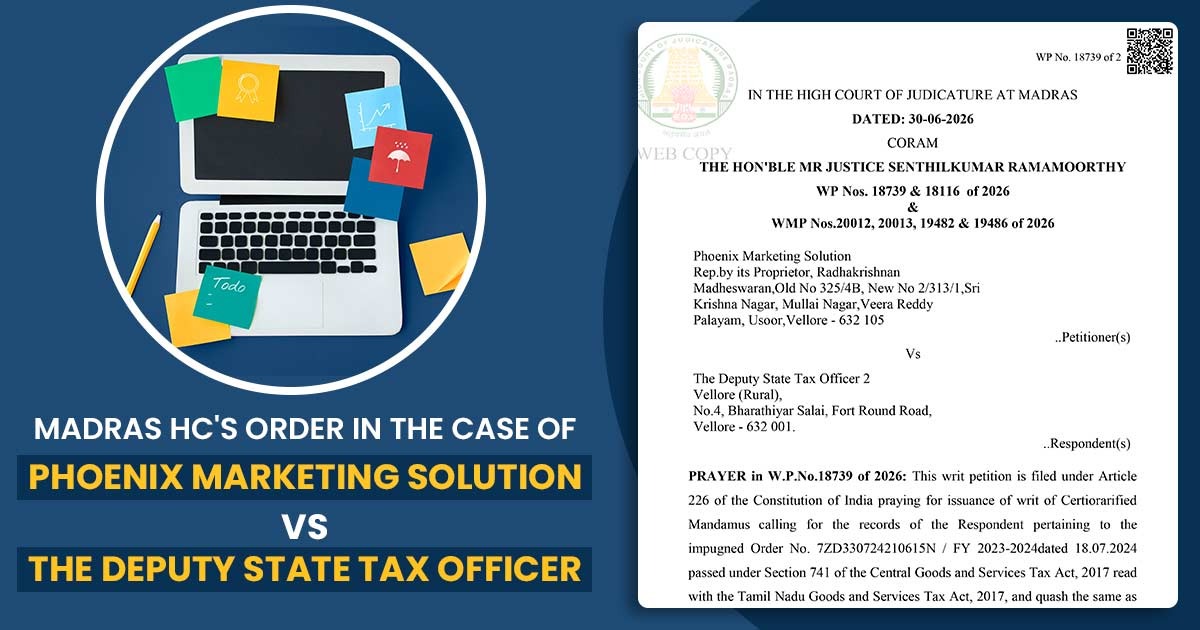
The Madras High Court on 30 June said that Input tax credit (ITC) could not be claimed on the grounds of a fabricated contractual arrangement, where the agreement and related invoices do not prove a genuine business transaction.
Justice Senthilkumar Ramamoorthy set aside the two writ petitions of a proprietorship contesting GST assessment orders for financial years 2022-23 and 2023-24, thereby upholding the demand for tax, interest and penalty confirmed under section 74 of the GST enactments (relating to tax not paid or short paid due to fraud, wilful misstatement or suppression of facts). He said that:
“Learned counsel for the petitioner is unable to controvert the above findings. In these circumstances, I find no infirmity in the orders impugned herein warranting interference in exercise of discretionary jurisdiction.”
The applicant sought an input tax credit for event management services purportedly rendered by Rathod Enterprise.
The petitioner challenged the assessment orders and requested the opportunity to submit additional documents. They also noted that a significant part of the tax demand had already been recovered.
In response, the State opposed the petitions, arguing that the petitioner’s reply had been thoroughly considered and that the assessment orders were based on detailed factual findings.
The tax authorities discovered numerous discrepancies in the agreement that the petitioner relied upon. The agreement dated December 23, 2022, was executed on stamp paper that was purchased only on May 4, 2023. The stamp vendor confirmed that the stamp paper was not sold by her and had, in fact, been stolen.
Afterwards, they discovered that the original agreement had not been produced and that the invoices placed reliance upon for claiming GST ITC were issued post-cancellation of the supplier’s GST registration. As per such findings, the authorities concluded that the contractual arrangement was fabricated and that there was no genuine business transaction between the parties.
The Court said that the applicant was not able to contradict such factual findings. It does not discover any ground for interference under its writ jurisdiction. Subsequently, the High Court set aside both petitions and kept the GST demand, interest, and penalty.
| Case Title | Phoenix Marketing Solution Vs The Deputy State Tax Officer |
| Case No. | WP Nos. 18739 & 18116 of 2026 |
| For Petitioner | Mr Suresh T, Monisha. S. |
| For Respondent | Ms.Amirta Poonkodi Dinakaran |
| Madras High Court | Read Order |