

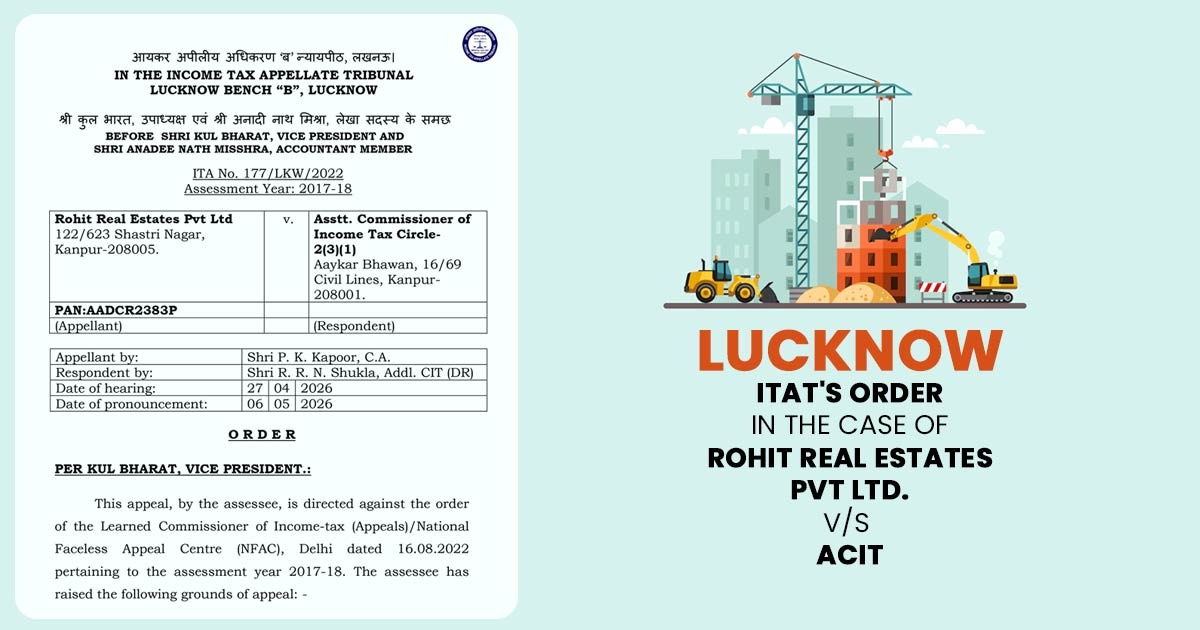
The Income Tax Appellate Tribunal (ITAT), Lucknow Bench, held that the calculated disallowance under Rule 8D(2)(ii) of the Income Tax Rules, 1962 must not surpass the exempt income so earned.
The taxpayer, Rohit Real Estates Pvt Ltd, was selected for ‘limited scrutiny’ through the Computer Assisted Scrutiny System (CASS) to analyse and validate the expenses made for earning exempt income. The Assessing authority did not consider the taxpayer’s submissions that it had not made any expenditure for earning the exempt income.
The CIT(A) kept the addition made by the lower authority and dismissed the appeal of the taxpayer. The appellant has mentioned that the CIT(A) had made a mistake in upholding the disallowance that had been made in the regular assessment order dated 28.08.2019 by applying Section 14 of the Income Tax Act, 1961, read with Rule 8D of the Income Tax Rules, 1962.
The applicant’s counsel before the ITAT expressed that the disallowance calculated via the Assessing Officer (AO) is more than such exempt income, and is not allowed under law.
Also, it specified that the law mandates recording of adequate satisfaction by the AO as to why the suo-moto disallowance made by the taxpayer is not accurate.
The AO calculated the disallowance at INR 2,57,458. ITAT said that some of the cases relied upon by the appellant deserve merit. This was the ruling in Nirved Traders Ltd v. Dy. CIT (2019), where it was held that a disallowance calculated under Rule 8D(2)(ii) must not surpass the exempt income so earned.
The bench of Anadee Nath Mishra (Accountant Member) and Kul Bharat (Vice President) asked the Assessing Officer (AO) to limit the disallowance to the extent of the exempt income, i.e., INR 31,070. The appeal was partly permitted.
| Case Title | Rohit Real Estates Pvt Ltd. Vs ACIT |
| Case No. | ITA No. 177/LKW/2022 |
| Counsel For PETITIONER | Shri P. K. Kapoor |
| Counsel For Respondent | Shri R. R. N. Shukla |
| Lucknow ITAT | Read Order |