

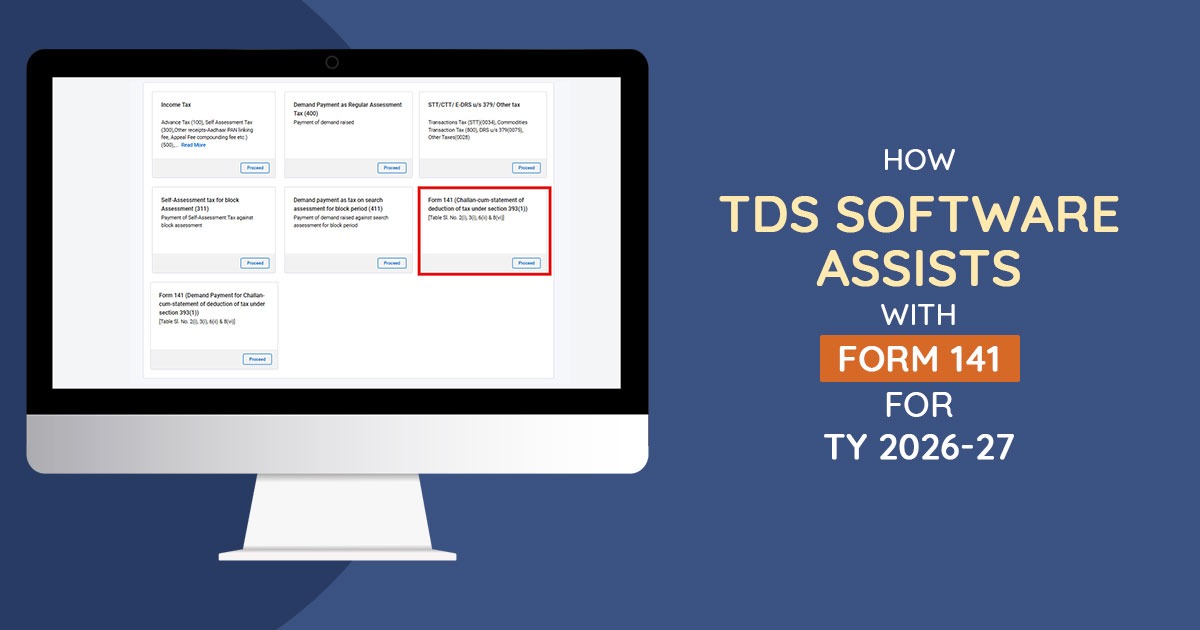
The non-business taxpayers handling their tax obligations have seen a transformation rolled out under the Income Tax Act, 2025, which came into force from April 1, 2026. The main factor for this change is the roll-out of Form 141, which is a unified challan-cum-statement that supersedes several older forms.
Navigating this change manually for TY 2026-27 is not easy. Here, advanced TDS software has become an important tool for compliance. The information on TDS software streamlining the transition to the new Form 141 has been specified in this blog.
What is Form 141?
It is a consolidated form made for Individuals and HUFs who are not obligated for a tax audit but still required to deduct TDS on specific high-value transactions.
Form 141 substitutes four older forms that were earlier used under the 1961 Act:
- Form 26QC: For rent payments exceeding INR 50,000 per month (Section 194-IB).
- Form 26QD: For payments to contractors and professionals (Section 194M).
- Form 26QE: For transfer of Virtual Digital Assets (Section 194S).
- Form 26QB: For purchase of immovable property (Section 194-IA).
How TDS Software Eases Smooth Compliance
TDS Software plays a key role in assisting businesses in maintaining proper and timely tax compliance and reducing the manual work for taxpayers. Below are the major points that we discussed:
Real-Time PAN Validation
By Portal: Under the latest norms, deducting tax at the incorrect rate is a common issue. If a seller or landlord has an inoperative PAN or is a “specified person” (non-filer of ITR), the TDS rate can jump from 1% or 5% to a flat 20%.
By Software: Modern software has the features of integrated API verification. When you enter the deductee’s PAN, the software verifies the real-time status on the Income Tax Department’s database. It notifies you if a higher deduction rate is crucial, saving you from future “Short Deduction” notices and interest penalties.
Managing Multiple Parties and Instalments
By Portal: The property transactions often include multiple buyers or sellers. Separate Form 141 filings are needed for each unique buyer-seller combination within the new system. Likewise, TDS is required to be deducted at every payment stage for property purchased in instalments.
By Software: The manual tracking of such instalments can cause calculation errors. TDS software keeps a ledger for every transaction. It holds data of the payments paid in previous months and computes the tax for the current instalment, even if it has multiple parties engaged.
Integrated Payment and JSON Generation
By Portal: The Time Limit is the main issue for taxpayers. Form 141 is required to be submitted and tax filed within 30 days from the end of the month in which the deduction was incurred.
By Software: In a few seconds, the software prepares the required JSON file in the digital format needed by the portal. Many software solutions propose an integrated payment gateway permitting you to pay the tax and file the statement in one streamlined workflow without leaving the application.
Automatic Categorisation via Schedules
By Portal: Form 141 is organised into four distinct Schedules (A, B, C, and D). Filing the incorrect schedule or mixing transaction types in a single form can cause immediate rejection by the portal.
By Software: A professional TDS software will alert you to select the accurate schedule based on the type of your payment. For instance, if you enter “Property Purchase,” the software defaults to Schedule B, confirming that you are filling out the accurate fields needed for property addresses and stamp duty values.
Automated Issuance of TDS Certificates (Form 132)
By Portal: When the Form 141 is submitted, there is more to do. You are required to issue a TDS certificate to the person you paid (the seller, landlord, or contractor). Under the 2025 Act, the old Form 16B/16C has been superseded by Form 132.
By Software: Once the return is processed, the software downloads the certificate from the TRACES portal and even emails it to the deductee. The same assures you fulfil the 15-day deadline for certificate issuance without manual tracking.
The Risk of Manual Filing in 2026
The AI-driven system of the Income Tax Department now reconciles data in real-time. A mistake, like using an old section code or a wrong property address, can lead to:
- Interest: 1.5% per month for delays in depositing tax.
- Section 234E Fees: A Rs 200 per day late fee for delays in filing.
- Data Mismatch: The seller will not see the tax credit in their AIS, which generates disputes and legal notices.
Closure: The transition to Form 141 for TY 2026-27 shows a step toward One-Stop compliance. The consolidation of forms makes life easier; however, the technical requirements for filing are higher than ever. TDS software is most effective for businesses, property buyers and tenants.
It serves as a bridge between the new law and the digital portal, confirming that your tax deductions are precise, your filings are timely, and your compliance is unfailing.
With the passing of the tax year, choosing the right TDS software partner is the key to maintaining seamless compliance and avoiding the headache of unexpected tax notices.