


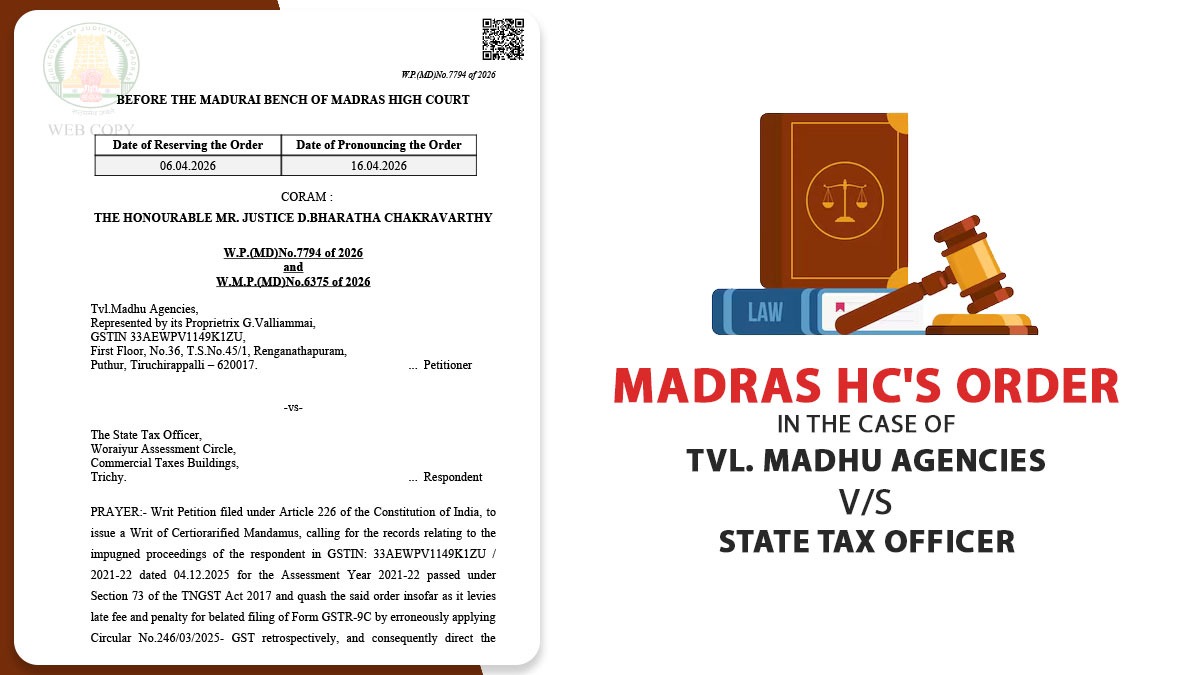
In a ruling, the Madras High Court has mentioned that GSTR-9C is part of the annual return under the GST law. If it is not filed, then GSTR-9 is incomplete; in this case, a late fee u/s 47 is applicable.
In this case, a late fee of Rs 1.69 lakh (Rs 84,700 for SGST and Rs 84,700 for CGST) was levied on the applicant, Tvl. Madhu Agencies, for the late filing of the reconciliation statement in Form 9-C for the FY 2021-22.
The legal deadline for filing the annual return Form GSTR-9 was December 31, 2022; however, the applicant filed the form dated January 13, 2023, which caused a delay of 13 days.
As the total turnover of the applicant was more than the threshold of Rs 5 lakh, it should file Form GSTR-9C, including the annual return. But at the same time, the applicant failed and filed Form GSTR-9C late on May 09, 2025. In conclusion, the tax authorities imposed the late fee by treating the date of filing of Form GSTR-9C as the date of proper filing of the annual return in Form GSTR-9.
The applicant mentioned that under the provisions of Section 47 of the TNGST Act, 2017, the late fee is charged only in cases where the annual return is filed late in Form GSTR-9, not for the GSTR-9C Form. It also claimed that the reconciliation statement requirement arises from rules, not from the act, and this should not draw penalties.
As per the taxpayer, “Under Section 47 of the TNGST Act, 2017, the late fee is only applicable for delays in filing the annual return in Form -9. Since the return was filed 13 days late, for which the late fee has already been paid, it cannot be extended to cover the delay in filing the reconciliation statement. Therefore, the impugned order is unsustainable.”
However, the claims were denied by the Court. It mentioned that u/s 44 of the GST Act, the annual return can consist of a reconciliation statement, and Rule 80(3) makes it mandatory for businesses with a turnover above Rs 5 crore to file GSTR-9C along with GSTR-9. The Court outlined that GSTR-9 filing without GSTR-9C is acknowledged as an incomplete return filing.
Also, the Court mentioned that the term “includes” in the law expands the ambit, which implies that GSTR-9C becomes part of the annual return. Thus, not submitting the same with the legal deadline is acknowledged as a failure to submit the required return, levying late fees u/s 47.
Important: How to Easily Prepare an Audit via GST Software?
Since the applicant did not file GSTR-9C within the statutory deadline set by law, the late fee was deemed valid. Accordingly, the writ petition has been dismissed; however, the applicant is permitted to file an appeal based on factual grounds.
| Case Title | Tvl. Madhu Agencies Vs State Tax Officer |
| Case No. | W.P.(MD) No.7794 of 2026 |
| For Petitioner | Mr N.Sudalai Muthu |
| For Respondent | Mr R.Suresh Kumar |
| Madras High Court | Read Order |






Sir, Madam,
In that case can CTO rely on the GSTR9 filed and raise a tax demand based on the GSTR9 ?
If both GSTR9 and 9C together make annual return can the late fee be split into one for GSTR9 (while is filed before due date) and balance for GSTR9C which is either late filed or not filed till date due to technical reasons listed below ?
This is because GSTR9 filing is accepted in online portal as it only takes the data filed by us.
However in case of GSTR9C Portal does validation and rejects. Local CTO is not able to resolve it. They ask us to take up with GST Technical team. There is no GST technical team to resolve this.
Sir, the late fee cannot be split in this manner. The full late fee will be applicable because GSTR-9C is also considered part of the annual return. For more detailed information, please consult a GST practitioner.