

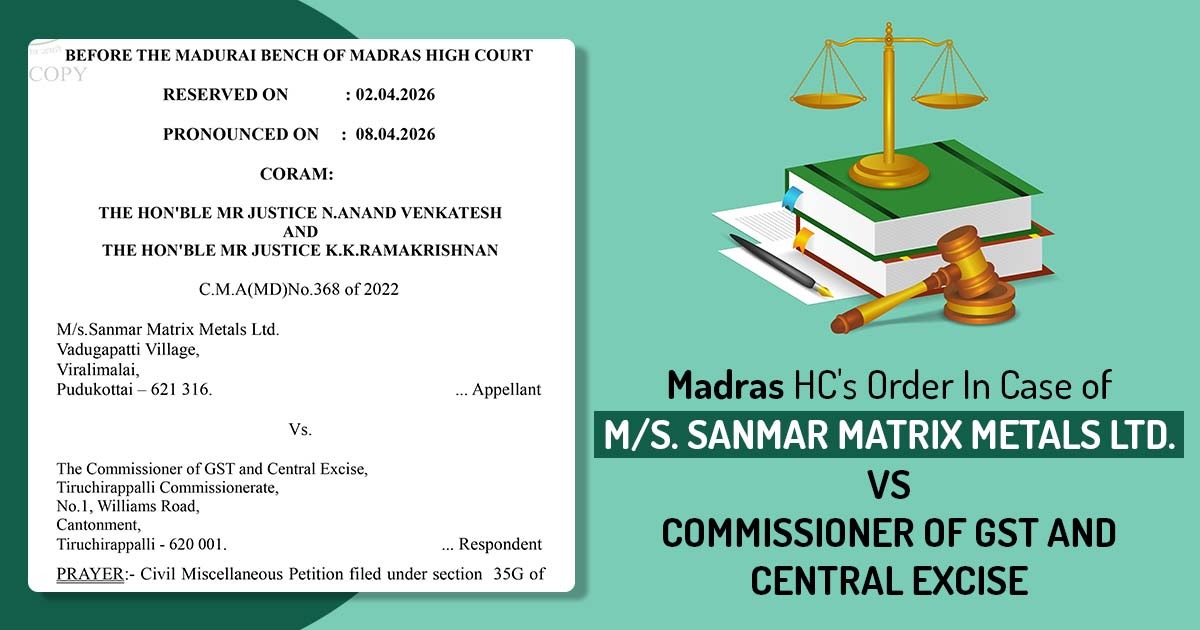
The Madras High Court, in a ruling, held that a refund could not be refused as per the limitation when the amount was appropriated during the pendency of an appeal and is deemed as payment under protest.
The case has arrived after the department refused CENVAT credit taken by the Sanmar Matrix Metals Ltd (appellant) and confirmed a demand of around Rs. 18.66 lakhs along with interest and penalty through an Order. This order has been contested by the appellant before the appellate authorities, and thereafter submitted an appeal before the CESTAT.
The tribunal, at the time of pendency of the appeal, passed an interim order, asking a pre-deposit of Rs 10,000 and granted a stay of recovery of the remaining dues. Despite the stay order, the department took possession of the rebate amount, which rightfully belonged to the appellant, and used it to settle their claimed debts.
Thereafter, the CESTAT set aside the demand raised against the appellant. Thereafter, the appellant sought the refund of the rebate amount, which was earlier appropriated. However, the department denied the request, citing that the claim was time-barred u/s 11B of the Central Excise Act, as it was not filed within 1 year from the Tribunal’s order.
Important: Madras HC Cancels GST Order for Non-Reply to SCN; Allows Fresh Adjudication with 10% Pre-Deposit
Appellate authority and CESTAT validated the rejection; the appellant submitted this appeal to the High Court.
The Division Bench, including Justice N. Anand Venkatesh and Justice K.K. Ramakrishnan, stated that the appropriation of the rebate amount was accomplished at the time of pendency of the appeal and even when there was a stay order by the Tribunal. The Court mentioned that the recovery could not be considered as a normal payment of duty and observed-
“If the revenue is permitted to adopt such novel ways to adjust the amounts by getting over an order of stay and thereby indirectly recovering the money, it cannot be construed as a duty payable as on the date of such appropriation.”
The court further noted that an appeal against a demand signifies an objection. For such matters, the amount recovered or adjusted in appeal needs to be deemed as a payment incurred under protest. The court said that-
“Now, where a person proposes to contest his liability by way of appeal, revision or in the higher courts, he would naturally pay the duty, whenever he does, under protest.”
The court said that under the second proviso to section 11B, the limitation of 1 year shall not be applicable where duty is paid under protest and noted-
“The limitation of one year will not apply where the duty and interest has been paid under protest.”
Also, the court denied the claim of the department that the refund claim arrived merely after the order of the Tribunal in 2018 and must have been submitted within 1 year. It elaborated that the same is not a simple refund case, but it is concerned with returning money that was taken at the time of a dispute.
Read Also: GST Refund Claim Cannot Be Denied Based on Retrospective Application of Rule 90(3) Proviso
The order of the CESTAT has been set aside by the Court and asked the department to refund the amount to the appellant within 6 weeks. Therefore, the appeal was permitted in favour of the taxpayer.
| Case Title | M/s. Sanmar Matrix Metals Ltd. Vs. Commissioner of GST and Central Excise |
| Citation | C.M.A(MD)No.368 of 2022 |
| For the Petitioner | Ms Radhika Chandra, M/s K.Vaitheeswaran |
| For the Respondents | Mr N Dilip Kumar |
| Madras High Court | Read Order |