

The Allahabad High Court has cancelled GST proceedings that were initiated against a company owner who has died. The court ruled that sending an SCN and making a judgment about taxation against someone who has passed is not lawfully permissible.
Justice Vikas Budhwar observed that although tax dues may be recovered from legal heirs under Section 93 of the GST law, such a determination must follow due process and be initiated against the legal representatives, not against the deceased assessee.
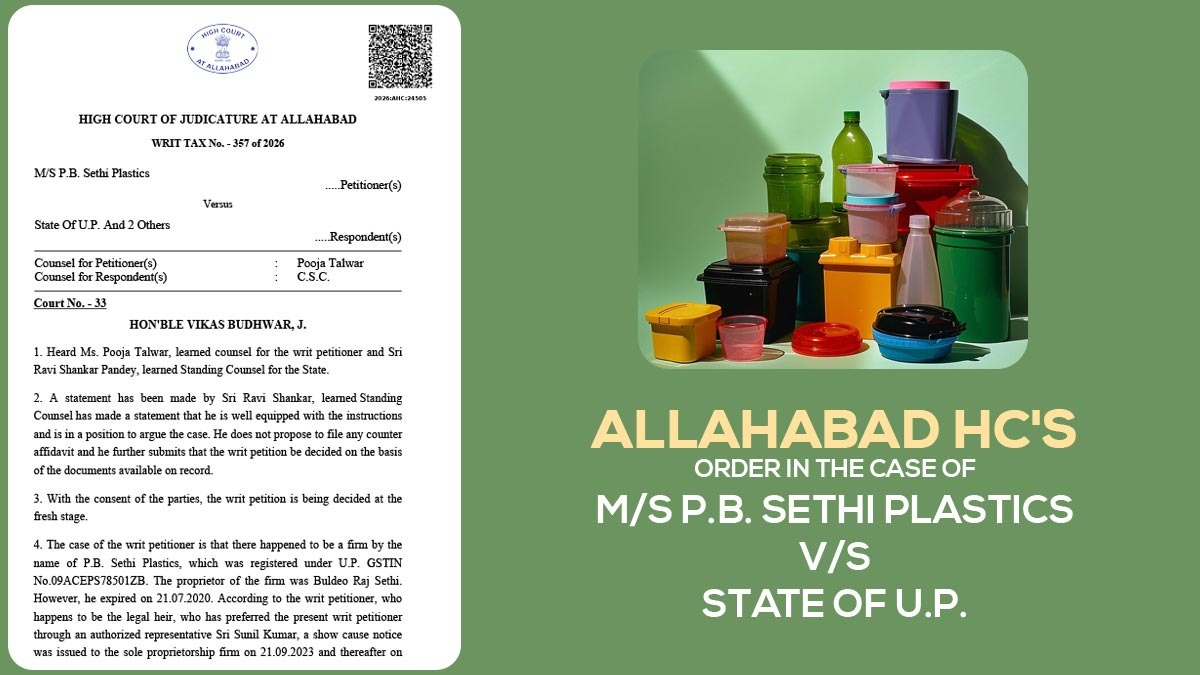
M/s P.B. Sethi Plastics, a sole proprietorship firm, has filed a writ petition, which was earlier registered under the U.P. GST regime. On 21 July 2020, the sole proprietor of the firm, Buldeo Raj Sethi, passed away. After his death, an application was submitted for cancellation of GST registration, which was permitted in October 2020.
Even after this, the State tax authorities issued a Show Cause Notice (SCN) on 21 September 2023 and thereafter passed an order on 20 December 2023 u/s 73 of the U.P. GST Act / CGST Act for the FY 2017-18, raising tax liability against the firm. In the name of the deceased proprietor, the proceedings were initiated.
The legal heir contested the adjudication order before the appellate authority. But on 26 June 2025, the appeal was dismissed on the grounds of limitation, prompting the applicant to approach the HC.
The issue before the Court was whether GST proceedings under Section 73 could be lawfully initiated and concluded against a deceased sole proprietor, and whether the appellate authority was justified in dismissing the appeal on the ground of limitation without examining this fundamental jurisdictional flaw.
The applicant stated that the firm is a sole proprietorship; therefore, proceedings cannot be carried on once the sole proprietor has expired. Issuance of SCN as well as adjudication order against a deceased person was void ab initio. Any allowable action must have been initiated against the legal heirs after furnishing them a chance of hearing.
Since the GST registration had already been cancelled, the legal heir could not have known about the adjudication order until much later. Therefore, the appellate authority made a mistake in rejecting the appeal due to limitations.
Reliance was placed on the Division Bench decision of the Allahabad High Court in Amit Kumar Sethia v. State of U.P., which examined Section 93 of the GST Act in a similar context. The department argued that, in terms of Section 93, legal heirs are responsible for discharging the tax dues of the deceased and that, consequently, the proceedings could not be considered unlawful.
It was further contended that the legal heir should have exercised due diligence to ascertain any outstanding tax liabilities. Post analysing the record, the Court mentioned that the facts were undisputed; in July 2020, the proprietor had died, the GST registration had been cancelled afterwards, yet proceedings u/s 73 were initiated in September 2023 and concluded in December 2023 against the deceased.
The Court, relying on an earlier Division Bench ruling, reiterated that Section 93 only addresses the liability to pay tax and does not permit the determination of tax liability against a deceased person. For a valid determination, a show-cause notice must be issued to the legal representative.
The Court then stated that the appellate authority made a patent error by dismissing the appeal on the grounds of limitation without addressing the fundamental illegality of the proceedings conducted against a dead person.
The HC, upon allowing the writ petition, quashed the adjudication order on December 20, 2023, issued u/s 73 of the GST Act, and set aside the appellate order on June 26, 2025, which rejected the appeal based on limitation.
Read Also: Allahabad HC Rejects Plea to Quash GST Fraud Notice, Orders Tax Department to Reveal Evidence
The Court defined that the annulment of these orders does not prevent the tax authorities from initiating fresh proceedings against the legal heirs, provided they follow due process, and it is permissible under the law.
| Case Title | M/S P.B. Sethi Plastics vs. State Of U.P. |
| Case No. | WRIT TAX No. – 357 of 2026 |
| Counsel for Petitioner | Pooja Talwar |
| Counsel for Respondent | C.S.C. |
| Allahabad High Court | Read Order |