

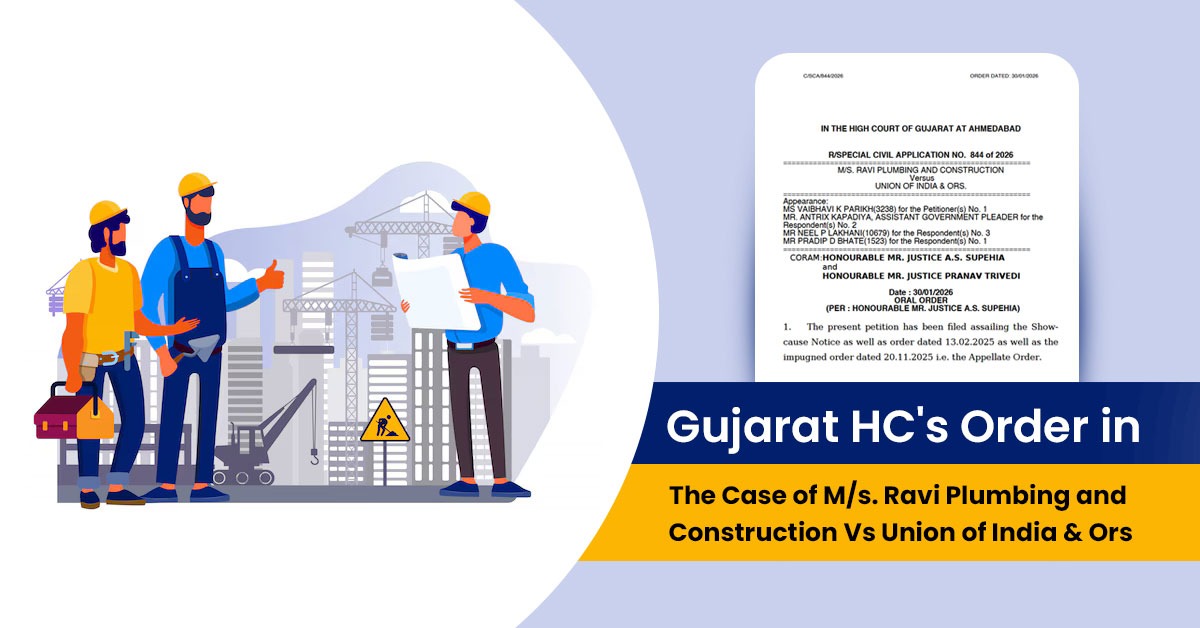
The Gujarat High Court recently issued a ruling in which it dismissed a writ petition that challenged the cancellation of GST registration. The court also upheld the rejection of a statutory appeal that was filed after the deadline. This decision highlights the importance of timely submissions in legal procedures related to GST matters.
Ravi Plumbing and Construction did not submit GST returns post the first quarter of FY2024-25. A Show cause notice has been issued by the GST department in Form GST REG-17 proposing cancellation of registration.
No response was submitted by the applicant to the notice, and the applicant also did not attend the personal hearing. An ex parte order in Form GST REG-19, cancelling the GST registration, was passed by the proper officer. The applicant mentioned that he was clueless about the notice and thereafter encountered technical issues on the GST portal while attempting to restore the registration.
After that, the applicant submitted a plea u/s 107 of the CGST Act on 12 November 2025, nearly 6 months after the cancellation order. On 20 November 2025, the appellate authority denied the appeal as it was submitted after the maximum permitted duration of 120 days. Subsequently, the applicant under Article 226 of the Constitution approached the Gujarat High Court.
The applicant before the HC said that the cancellation order was passed without proper hearing, and the delay would have occurred because of technical issues and incorrect login information on the GST portal. The applicant asked the Court to furnish relief via its writ authority.
The department said that Section 107 permits only 90 days to file an appeal and an extra 30 days for condonation. No authority has the power to condone the delay after the 120-day limit is exceeded. It was claimed that the writ jurisdiction could not be used to extend the limitation specified under a special law.
The Division Bench of Justice A.S. Supehia and Justice Pranav Trivedi stated that the delay facts were not disputed. The Court elaborated that Section 107(4) limits condonation to merely 30 days after the initial period.
After the same time, the right to appeal has come to an end. The court noted that although the powers under Article 226 are broad, they cannot override clear legislative intent.
Read Also: Calcutta High Court Allows Assessee’s Revocation Plea Against GST Registration Cancellation
In reliance on the Apex Court’s decision, the HC relied on Assistant Commissioner (CT) v. Glaxo Smith Kline Consumer Health Care Ltd., elaborating that writ jurisdiction could not revive a remedy that is already limited in time.
The Court specified that reasons such as portal problems and incorrect credentials were not valid reasons to cross statutory limits. The taxpayers are anticipated to analyse the GST portal regularly.
The Court denied interfering with the appellate order. The writ petition was dismissed, and the cancellation of GST registration and rejection of the appeal stayed valid.
| Case Title | M/s. Ravi Plumbing and Construction Vs Union of India & Ors |
| Application No. | 844 of 2026 |
| For the Petitioner | Ms Vaibhavi K Parikh, Mr Antrix Kapadiya |
| For Respondent | Mr Neel P Lakhani and Mr Pradip D Bhate |
| Gujarat High Court | Read Order |