

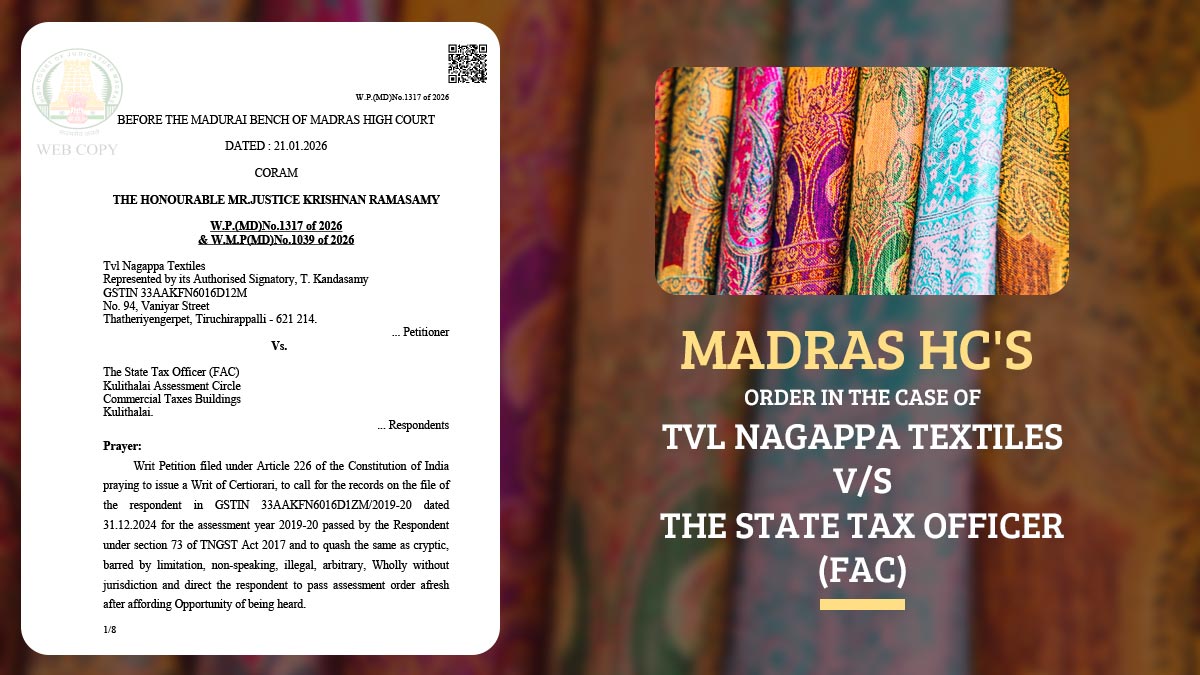
A recent ruling by the Madurai Bench of the Madras High Court has overturned a tax assessment order related to the Goods and Services Tax (GST) in Tamil Nadu. The court found that the tax authorities did not allow the taxpayer an opportunity for a personal hearing before making their decision.
Additionally, the court stated that simply posting notices online, without making sure the taxpayer actually received them, is not sufficient and is just a formality that doesn’t fulfil legal requirements.
The bench of Justice Krishnan Ramasamy noted that while service of notice via uploading on the GST portal is a legally recognised mode, tax authorities cannot mechanically proceed with ex parte orders when there is no answer from the taxpayer.
The officers are bounded with duty to see other modes of service mentioned u/s 169 of the GST Act, such as registered post acknowledgement due (RPAD), particularly when repeated portal notices elicit no response. Services will not be effective due to the failure to perform the same, and it defeats the objective of the law.
The applicant stated that because all notices and communications were exclusively uploaded to the GST portal, they remained unaware of the proceedings and failed to respond within the statutory period. Consequently, the assessment was finalised ex parte without providing the assessee an opportunity for a personal hearing.
The State at the time of hearing considered that although notices had been uploaded on the portal therefore no chance of a personal hearing before passing the impugned order. The applicant shows its willingness to deposit 25% of the disputed tax if the case is remanded for fresh consideration.
Read Also: GST Impact on Textile Industry in India
The court criticised the method of passing an ex parte order only to finish the procedural needs stated that these measures were merely directed to unnecessary litigation, wasting the time of departmental officers, appellate authorities, tribunals, and constitutional courts alike. The court said that the effective service of notice is an integral part to ensure the norms of natural justice and obtain the goals of the GST regime.
The HC permitting the writ petition set aside the impugned assessment order and remanded the case back to the assessing officer for fresh consideration. The same relief was made conditional on the applicant depositing 25% of the disputed tax amount within 4 weeks.
Applicant must submit a response, including supporting documents, within 3 weeks of the payment, the court said. After that, the assessing authority was asked to provide a 14-day notice for a personal hearing and pass a fresh order on merits as per the law, post-hearing, the taxpayer.
Following these guidelines, the writ petition was resolved, emphasising the importance that GST proceedings must not only follow legal service requirements but also provide taxpayers with a genuine chance to be heard before any adverse orders are made.
| Case Title | Tvl Nagappa Textiles vs The State Tax Officer (FAC) |
| Case No. | W.P.(MD)No.1317 of 2026 |
| For Petitioner | Mr R.Suresh Kumar, AGP |
| For Respondent | Mr.R.Suresh Kumar, AGP |
| Madras High Court | Read Order |